Check out the courses (products) in the left column! You can get ALL of them free, with a simple donation
of $45.00 or more. Most of those courses will show you how to put the $45 right back into your
own pocket, A THOUSAND TIMES!
Check out the courses (products) in the left column! You can get ALL of them free, with a simple donation
of $45.00 or more. Most of those courses will show you how to put the $45 right back into your
own pocket, A THOUSAND TIMES!
BUY ONE PRODUCT, GET ALL THE OTHERS FOR FREE!
Plus, you'll receive a downloable copy of this entire course that may easily be burned to a CD.
**************************************************
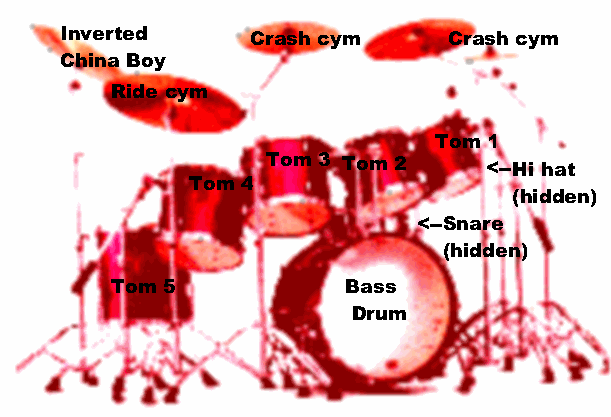
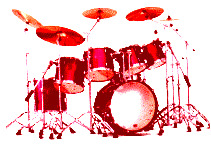
Tom Toms: Toms may range in size from 6" to 18" (inches) in
diameter and the may also come in many depths, ranging from 3"
to 16" (inches.) Usually, the larger a tom tom is . . . the deeper its
tone will be. So, we arrange our toms in a clockwise (circle) fashion
around the kit. The largest tom (Floor Tom) will be on our far right and
all the smaller toms will be arranged in order according to size . . . leading
around to the floor tom. (T1, 2, 3, etc.)
FLOOR TOM: The Floor Tom is an abnormally large Tom Tom and
it usually has legs on it. It stands (or sits) on its own legs. It usually
isn't attached to the bass drum as some of the smaller tom toms may be. (FT)
CRASH CYMBALS: Crash Cymbals may range in size from 4"
or 5" inches up to 18" in diameter. They come in all sorts of weights
and thicknesses. We use them as punctuation in the music . . . crashing
occasionally to 'emphasize' certain parts of the music that needs special
accents or kicks.
Crash cymbals are usually placed on adjustable stands by
themselves but every drum set manufacturer may try to come up
with many, many different types of stands to make their drum sets
seem better than drum sets made by the competition. (Crash)
There is no specific size or number of drums that make up a
complete drum set. You may have as many tom toms or cymbals
as you wish. Some drummers may use two bass drums. We all
like to try to be different. The more drums we have, the more tonal
variations we have to choose from as we play. More is better . . . if you
have the money . . .
BUT,
For learning purposes . . . we can get by with just a Bass, Snare and maybe one
cymbal. This would be the absolute MOST basic drum set. Usually
it is best if we can start out on a set with two or three Tom-toms, a Hi-hat,
Ride Cymbal, a Crash and (of course) a Bass drum.
Now . . . go to the following URLs . . . (lessons.)
The following four lessons will get more into detail about when and what you
should buy, plus how to assemble and tune them, once you have them at home.
DRUMS: WHEN TO BUY.
DRUMS: HOW & WHAT TO BUY . . .
HOW TO ASSEMBLE A DRUM SET . . .
HOW TO TUNE YOUR DRUMS . . .
By the time you have completed the above four lessons,
you will know exactly what all the drums look like, where
they should be placed and what they should sound like.

****************************
Speaking of soul, how's yours?
I'll
offer you mine if you'll click here!
****************************
International copyright secured @ Bill Powelson 1994 all rights reserved.






 Place a permanent ad here.
 School of Drums